Forming and Storming, read for a neurodiverse team
The first two stages of Tuckman's model are where a team's defaults are set. Get them right and the rest is easier. Get them wrong (usually by assuming everyone reads social cues the same way) and the team carries that cost for months.
Bruce Tuckman, working as an Army psychologist in 1965, watched a lot of small groups and named the pattern he saw: groups go through five stages: Forming, Storming, Norming, Performing, and (added in 1977 with Mary Ann Jensen) Adjourning. The model has lasted because it describes the actual experience of joining a team: things start polite, then surface conflict, then settle, then perform, then end. We're going to read those stages for a neurodiverse team — because the model itself is neutral, but the defaults managers use to move a group through each stage are often not.
Forming
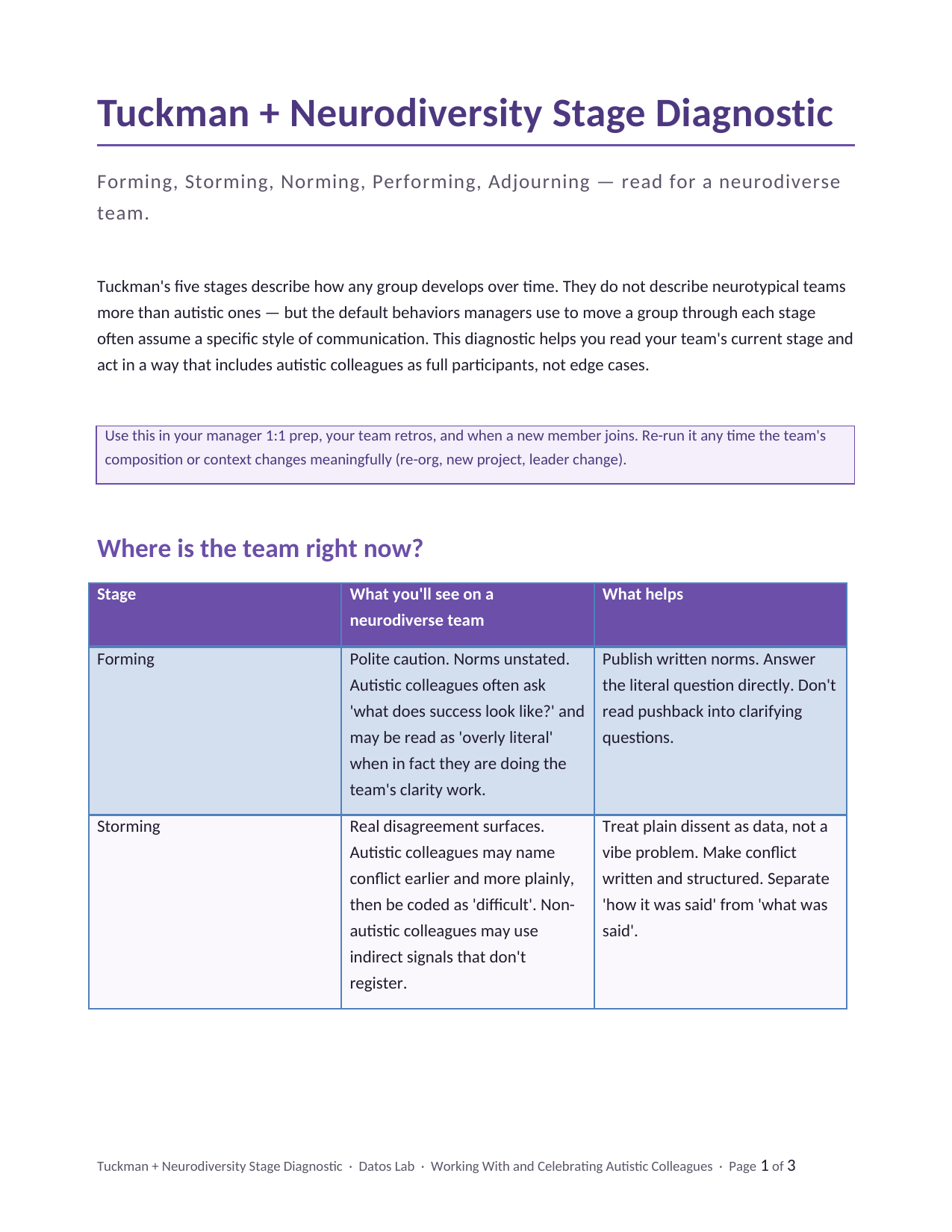
The team is new: new project, new members, new manager. Polite caution dominates. Norms are unstated. Everyone is reading the room.
On a neurodiverse team, Forming has one common failure: autistic colleagues ask 'what does success look like?' early and plainly — and get coded as 'overly literal' or 'high-maintenance'. They are not being high-maintenance. They are doing the team's clarity work that nobody else volunteered for. Their question is the question.
What helps at Forming:
- Publish written norms (meeting cadence, channels, decision rights) in the first week, not month three.
- Answer the literal question directly. 'What does success look like for this project?' deserves a written, specific answer, not an aside.
- Don't read clarifying questions as pushback. If you find yourself thinking 'they ask too many questions', the team's brief is too vague.
Storming
Real disagreement surfaces. The polite caution wears off. People test boundaries.
On a neurodiverse team, Storming has a different shape. Autistic colleagues often name conflict earlier and more plainly ('I disagree with this decision because…') and then get coded as 'difficult', 'aggressive', or 'not collaborative'. Meanwhile non-autistic colleagues may signal disagreement indirectly (through tone, scheduling, who they Slack DM) and that signal may not register with autistic teammates at all. Both halves of the team feel the other half is not playing fair.
What helps at Storming:
- Treat plain dissent as data, not a vibe problem. The 'least excited' voice is information.
- Move conflict into writing where possible. A written disagreement is easier to read on both sides than a microaggression-laden meeting.
- Separate 'how it was said' from 'what was said'. The first is style. The second is the work. Address the second first.
Learner action
Identify your team's current stage on Forming or Storming. Write down one specific recent incident that locates them there.
Tuckman + Neurodiversity Stage Diagnostic
Read your team's current stage in 15 minutes. Pick one concrete inclusion move per week. Re-run any time the team or its context changes.
Action: Complete the learner action above, then slide to continue.