Why reporting up to an autistic manager has its own playbook
Most professional-development material assumes the autistic person is the report or the peer. When the autistic person is your boss, the same Double Empathy Problem runs in the other direction — and almost no one teaches you how to meet it.
Open any popular management book and search for the word 'autistic'. If you find anything, it will be in a chapter on managing 'difficult' or 'neurodivergent' direct reports. The reverse case (you report to someone autistic) is essentially absent from the canon. Yet autistic professionals climb. They become team leads, program directors, EDs, founders. Their direct reports show up on day one without a roadmap.
The result, repeatedly, is the same pattern. Non-autistic reports interpret their autistic manager's directness as displeasure. They read terse Slack replies as anger. They decide the silence after their idea was rejection rather than processing time. They start hedging, padding, performing: exactly the kind of indirect communication that an autistic manager finds hardest to parse. The relationship then deteriorates not because of substance, but because both sides are reading the wrong dialect.
The Double Empathy framing from Module 1 is just as true going up. Milton's framing applies regardless of org-chart direction: both parties are working across a communication dialect difference. The asymmetry is that your manager has formal power, so the cost of misreading them lands on you. Closing that cost requires you to do real adaptation work — not because your manager is broken, but because the relationship is yours to invest in.
What this module is not: a list of ways to 'handle' an autistic boss. The framing in this course refuses 'handling' people. What it is: a set of muscles you can build to be the kind of report that an autistic manager finds easy to manage well. The same muscles, incidentally, will make you better at reporting to any manager.
One assumption we're making throughout: your autistic manager is competent, doing the job in good faith, and (like every manager) has gaps. We're not coaching you on what to do if your manager is bad. We're coaching you on what to do when the relationship is good and you want it to stay that way.
Learner action
Write down one moment in the last month where you read your manager's tone as displeasure. Then write one non-displeasure interpretation that is equally consistent with what they said.
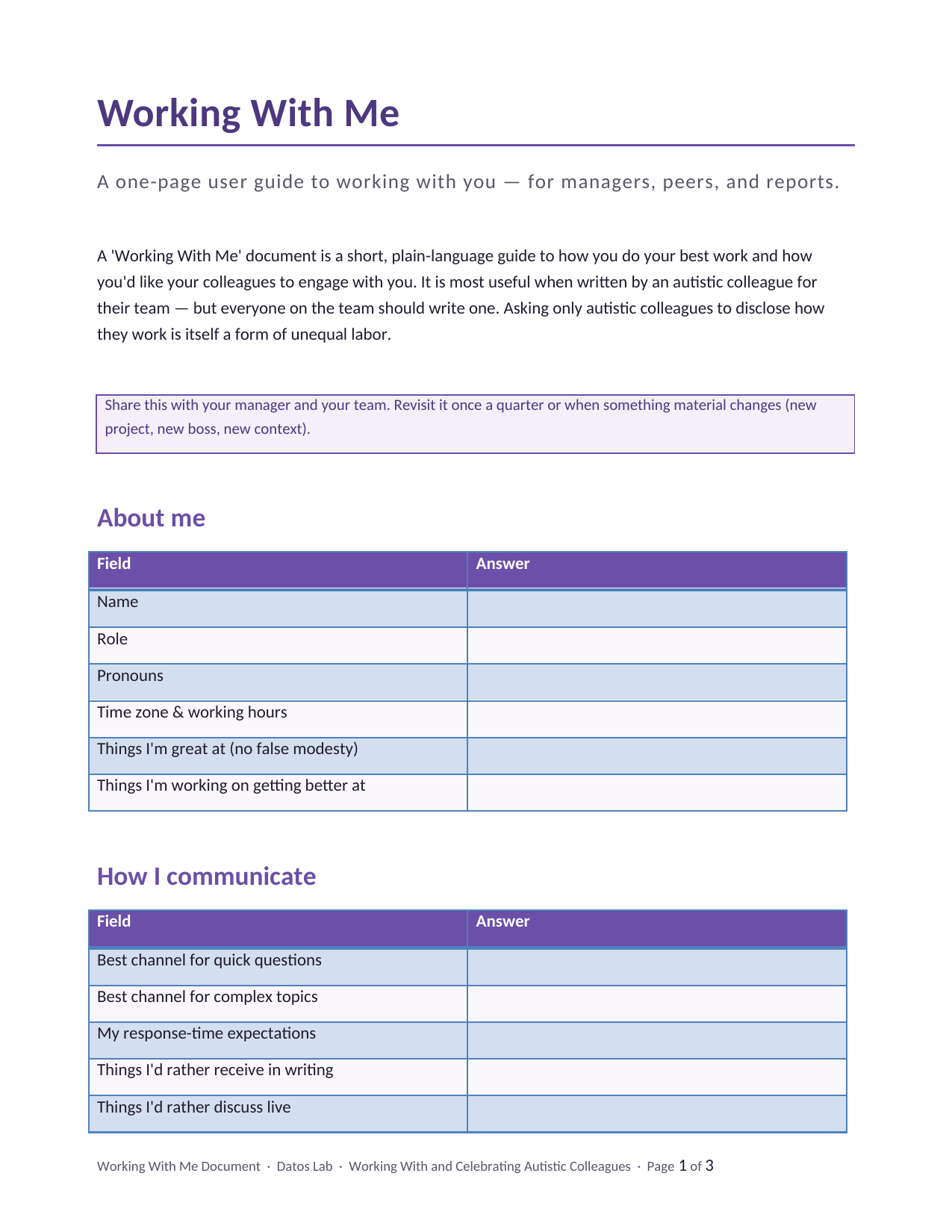
'Working With Me' Document Template
A one-pager every team member writes, your manager's too. Removes guesswork in the first 90 days and any time the team's context changes.
Action: Complete the learner action above, then slide to continue.