The conversation, if and when it happens
Sometimes the masking-and-burnout conversation does need to happen. It belongs in a 1:1, after you have already changed conditions, never as a surprise, and never as clinical diagnosis.
You should not initiate a masking conversation with an autistic colleague unless you have already changed at least one of the four levers, the change is visible, and a real 1:1 trust relationship exists. A surprise conversation about masking (initiated by a manager who has not yet changed conditions) lands as another piece of mask labor: now they have to manage your feelings about their masking. Don't do that.
If the conversation does happen, the rules:
- Bring concrete observations, not psychoanalysis. 'You've taken sick days the Friday after every late-running launch — I want to make sure that pattern isn't being driven by something I can change.' Not: 'I think you might be burning out.'
- Lead with what you'll change, not what they'll change. 'I'm dropping camera-on as a default and moving status updates to writing. I want your read on whether either of those would help.' Not: 'have you considered taking more breaks?'
- Don't diagnose. You are not a clinician. The words 'burnout', 'masking', and 'overload' belong to the colleague to use about themselves, not to you to assign to them.
- Don't ask for disclosure. If your colleague has not told you they are autistic, do not infer or imply it. You can change conditions without anyone disclosing anything.
- Close with a written summary. What you'll change, by when, and one optional thing they asked for. Memory does not adjudicate well later; the doc does.
Callout: bodies, hormones, and chronic illness as working conditions. A 2025 paper by Bowden & Miller, 'Menstruation among autistic adults', documents a pattern that workplace literature has historically ignored: menstrual cycles can substantially intensify sensory overload, fatigue, and migraine in autistic adults — and not just in autistic women. Chronic illness, hormonal therapy, and post-illness recovery operate similarly. The managerial implication is not 'ask people about their cycles'. It is that the four levers (time, information, environment, recognition) need to flex on a non-linear schedule. A predictable bad week, a flexible quiet day, a non-camera-default meeting, a 'no new commitments' Slack status; these are accommodations for bodies, and they are part of equitable management. Don't gender them and don't make them special — just build them in.
The point of the conversation, when it happens, is to make the working relationship more sustainable. The point is not to extract disclosure, perform empathy, or tick a manager-training box.
Learner action
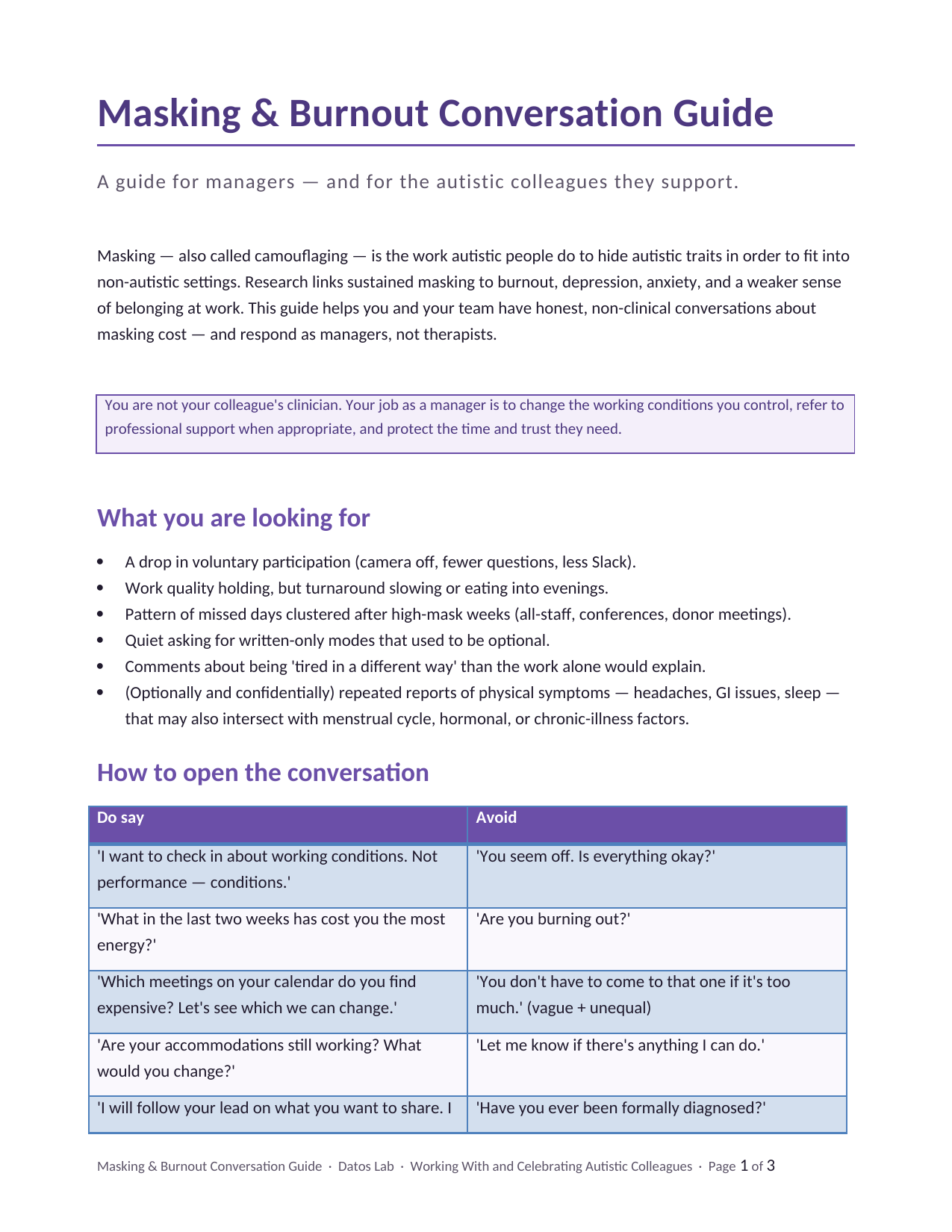
Open your Masking & Burnout Conversation Guide template (this module's download). Fill in the 'what I have already changed' section before you ever schedule a conversation.
Masking & Burnout Conversation Guide
A non-clinical conversation guide for managers. What to say. What to avoid. Four concrete levers. Includes a callout on menstrual, hormonal, and chronic-illness needs as working conditions.
Action: Complete the learner action above, then slide to continue.